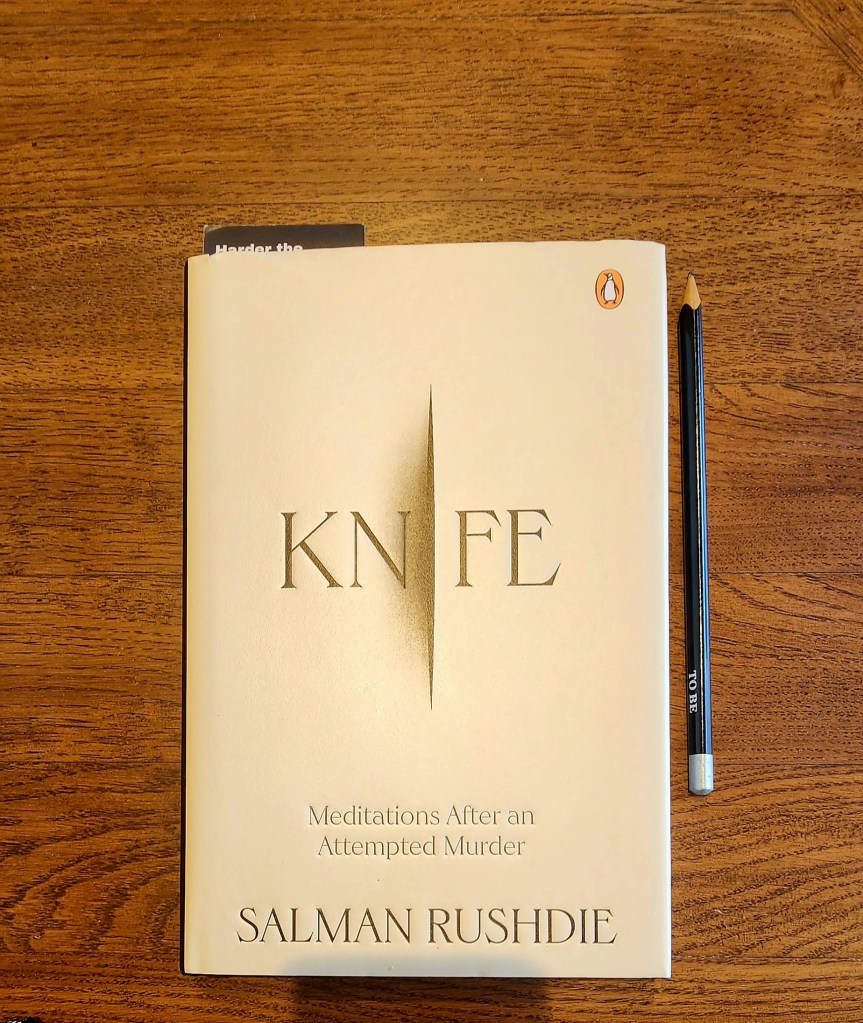
I sat with this book for a long time. I didn’t know what I felt more – angry or hopeful.
“I would answer violence with art.”
But how to do it? Especially when one imagines the intensity, the horror, the sheer inexplicability of violence? Violence that beats its bare chest over the unarmed, defenceless body of a 75-years old man, turning bloody at an alarming rate under the merciless, unflinching, repeated stabs of a sharp knife, driven by a brain-washed bigot of mere 24-years, a mind-boggling fourteen times over twenty-seven long seconds? Violence that snips the connection with loved ones and rams one’s very existence into the limbo that carries no certainty of a morning?
How does one answer such violence with art?
In Knife, Salman Rushdie, truly, rises to become that artist who defies norms of pain, injustice and loss with his sublime friendship with words, and relationships forged in their hearth.
August 12, 2022 at Chautauqua turned his life upside down. The dark shadows of a fatwa issued 33 years ago, once again, blackened his sky and fell on him in murderous stabs. The stabs charted a manic path, ripping through multiple organs – palm, fingers, face, lips, neck, chest – and erasing one altogether. The left eye – the vision in it was gone.
Emergency admission and a series of complex surgeries held the life whiff from leaving him completely. But what lay ahead was the most arduous eight months of his life – the recovery, of body and (badly damaged) spirit.
“When Death comes very close to you, the rest of the world goes far away and you can feel a great loneliness. At such a time kind words are comforting and strengthening. They make you feel that you’re not alone, that maybe you haven’t lived and worked in vain. Over the next twenty-four hours I became aware of how much love there was flowing in my direction, a world-wide avalanche of horror, support, and admiration.“
The ardent love and support of his wife, Eliza Griffith meets the dogged belief of his children of his recovery, the immediate action of the Chautauqua staff and audience (of whom one kept his thumb on Salman’s neck so that the bleeding is arrested till the helicopter comes to pick him up from the venue) multiplies with the resolve of his doctors and other medical staff, rousing gathering of his fellow writers and readers augments his pen that brings Victory City, and the Knife, to blazing life.
I have seen death, up close. It chooses its people. And sometimes, we cannot make sense of its decisions. Why? Why? We bang the doors of anyone who cares to withstand our unravelling and ask – Why him? Why her? There are answers, perhaps. But none of them hit home. Salman, once back in America, still frail but spirited, meets friends who are fighting their own battles. Martin Amis, his friend for long, writes this heartwarming note:
“When we recently saw each other for the first time since the atrocity, I have to admit that I expected you to be altered, diminished in some way. Not a bit of it: you were and are intact and entire. And I thought with amazement, He’s EQUAL to it.“
Few months later, Martin left peacefully in sleep. If Salman was troubled by it, he doesn’t hide it. Why him?
Time spent with his dear friends – Martin Amis, Ian McEwan, Paul Auster – fortified his own restoration. Remembering the barbaric knife attacks on other writers like Naguib Mahfouz and Samuel Beckett brought him a stabilizing perspective of discarding rationale to such dastardly acts. Perhaps that’s why he finds the courage to steer clear of the imaginary conversations he was holding with his attacker, whom he named Mr. A, across multiple sessions. But how else could he have made peace with his (near) nemesis if not with words? How else would he have turned his howls and torment into barbs of humor if not with words? Words were his only weaponry.
And the most beautiful part of words? They are entirety in themselves. They need no crutches, no form, no closure. Unsuppressed words can fly till sky and drag the greys away. That’s precisely what the words do for Salman – all the words of family, friends, writers, readers take him to a place, after thirteen months, where it all began – Chautauqua. And as he stands at the exact spot where he had fallen, looking at the now empty amphitheater, he feels triumphant.
‘I remembered, but refrained from reciting, lines from “Invictus” by W. E. Henley. “Under the bludgeonings of chance/My head is bloody, but unbowed.”’
Thank you for writing this book. I feel a throbbing vein of resilience in its every page.
—
Note: We lost Paul Auster yesterday. But he shall live on in his words. Many, many of them, quietly, rousingly, honoring their master.

