Tea person rolls in tea estate.
A hyperbole, I agree. But then, the experience of walking through one of the oldest tea estates of Sri Lanka felt like an embrace of the green elixir, nothing less.
At Halpewatte Tea Estate and Factory in Ella, we were given a short introduction of tea which was fascinating to absorb.
At 3 different heights above sea level – 2500 feet, 3500 feet and 6000 feet – spread acres and acres of tea plantation estates, giving a wide variety of teas.
A perfect pluck has 4 leaves + 1 tip: the tip at the top, followed by 2 leaves (1 – 2) below it and another two (3 – 4) further down it.
- Tip has nearly zero caffeine and maximum minerals, making it the base of the healthiest tea. Tips go into making teas like Silver Needle Tea, Gold Needle Tea and similar. Needless to say, this is also the most expensive among the three types.
- 1 – 2 are the next best, in terms of health benefit, and have antioxidants, along with minimal caffeine. These leaves are used to make all the Green Teas.
- 3 – 4 are the base for my favorite Black Tea. Robust and strong, this is the most popular tea in terms of consumption.
In the Halpewatte Tea Estate, 3 – 4 types of leaves are used to make 19 grades of black tea.
Pro Tip: Smaller the size of the leaf, stronger the taste of the tea coming off it. So, check the leaf details on the tea pack next time you are thinking of buying one.
At the tea-tasting session, we sampled 5 different grades of tea, along with a little suggestion on the ideal time to have them.
- OPA: Orange Pekoe A1 (Orange is the color, Pekoe is Black tea). This is ideal as tea taken before going to bed in night.
- OP: Orange Pekoe. Slightly stronger than OPA. Ideal to be consumed during afternoons.
- BOPS: Broke Orange Pekoe Special. A Stronger tea than the other tea. Can be take in morning/ forenoon.
—
As part of the tour, we were given a opportunity to climb up, get onto the tea estate and pluck the leaves by ourselves. Despite a tad slippery soil and elevation, the green blanket quickly took me over. But plucking the ideal leaf? Ha! I was far from it. One needed patience, balance and a sharp eye. That’s where we met Muruga – a worker on this tea estate. A veteran of tea leaf plucking, she showered us with generous smiles and guidance to perfect picks.
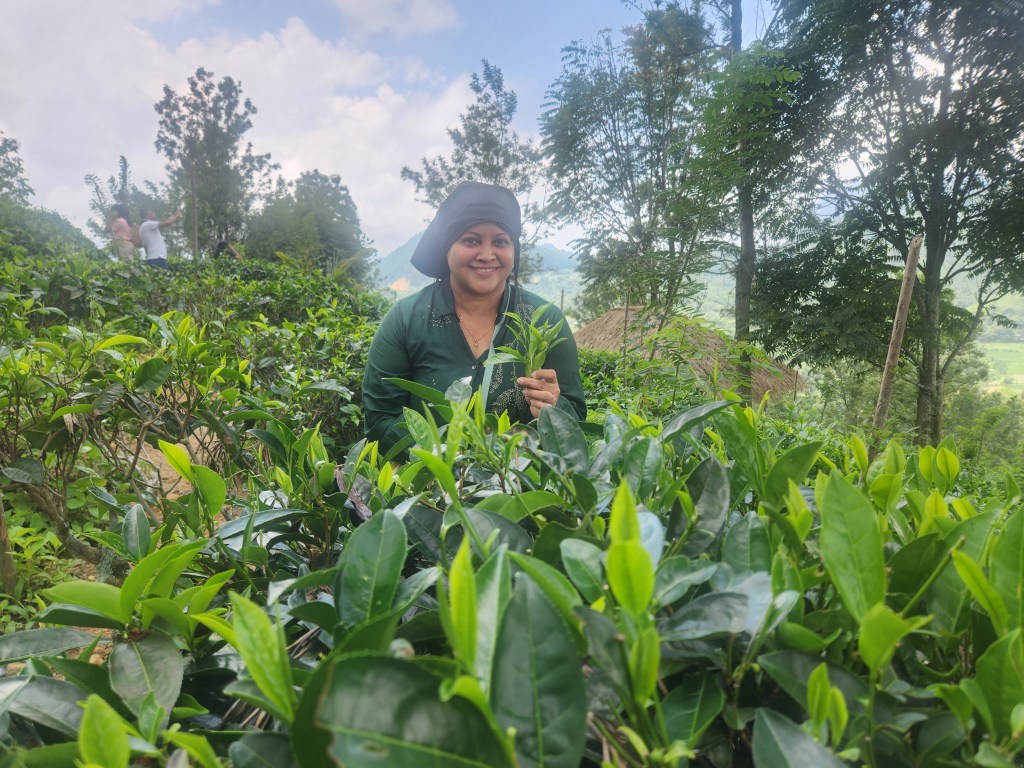
It may be noted that the workers who are engaged in plucking the tea leaves here start early at 7 in the morning and close by 5 in evening. They get paid for the day’s work only if they gather a minimum of 20 kgs of tea leaves. Most workers try to gather 60-70% of the total ask before 12 noon inorder to avoid labouring under the scorching afternoon sun.
Over 4-5 kg of leaves go into making 1 kg of packaged tea. So, the next time, you discard a cup of tea with some tea still left in it, think about the year-long toil of Muruga and her ilk.
As I picked up some of their wonderful concoctions from the Halpe Tea Shop and Lounge at the end of the tour, I found myself feeling a tad sombre, knowing the hardships behind a perfect cuppa and also blessed to have access to this refreshing beverage.
******
Find more about the tour here:
 SEEMITA DAS